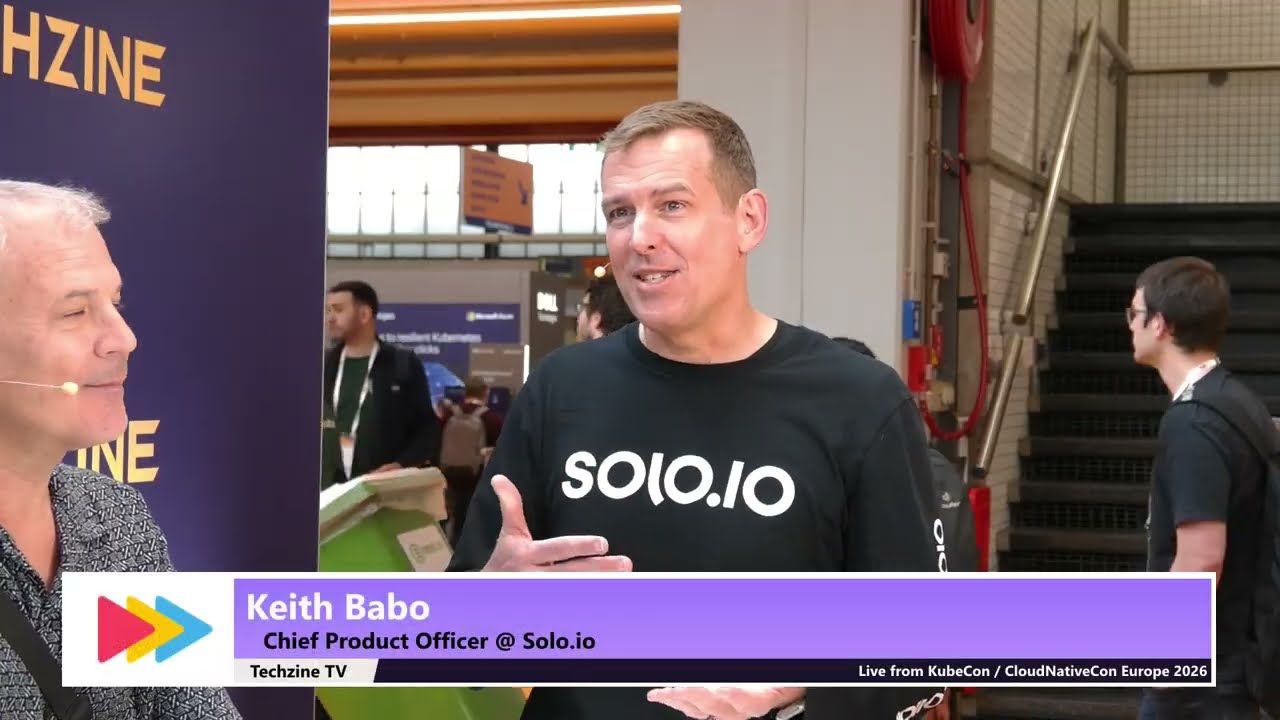
What happens when AI development teams move faster than platform teams can track? Solo.io founder Idit Levine and Chief Product Officer Keith Babo reveal the critical infrastructure gap threatening AI production deployments—and how their newly announced Agent Eval completes the solution.
In this exclusive interview from KubeCon and CloudNativeCon Europe 2026, discover why organizations deploying AI agents face unprecedented governance challenges. Learn how agents running across AWS, Google Cloud, and SaaS platforms create blind spots for security teams, and why traditional Kubernetes abstractions fall short for agentic workloads.
The conversation reveals a comprehensive approach to managing AI agents in production environments. From extending Kubernetes with first-class agent APIs to enforcing security policies across incompatible cloud provider systems, Solo.io’s platform addresses the complete lifecycle of agentic infrastructure.
What you’ll discover in this video
Levine and Babo walk through the evolution of Solo.io’s AI infrastructure platform, explaining how each component solves specific production challenges. They demonstrate why centralized visibility matters when AI developers can deploy agents anywhere, and how the agent loop actually works when tools are called and results returned to LLMs.
The interview explores critical questions facing platform engineering teams today:
Key topics covered
- Why AI pilots and POCs struggle to reach production, and what’s different about agentic workloads
- How Agent Registry creates a catalog of approved components across multiple runtimes
- The role of Agent Gateway in enforcing unified access policies regardless of cloud provider
- How agentevals validates agent behavior by getting inside the agent loop
- Why observability alone isn’t enough—platform teams need to verify business logic execution
- Techniques for testing model downgrade from Opus to Sonnet without degrading performance
- How Solo.io’s pluggable architecture extends to SaaS platforms beyond traditional cloud providers
- The open-core business model and path to CNCF contribution
Learn the missing piece for AI agent production
Levine uses a compelling analogy about homework supervision to explain why current approaches fall short. Platform teams can restrict which tools agents access, but they can’t verify whether agents execute efficiently or follow intended business logic. agentevals solves this by benchmarking every step of the agent loop against golden datasets.
Babo reveals a common cost optimization challenge that agentevals addresses: developers start with powerful models but may not need that capability. However, unlike traditional infrastructure where machine type doesn’t affect application behavior, downgrading LLMs can degrade performance. Watch to understand how probabilistic testing enables confident model selection.
From networking pioneers to AI infrastructure leaders
The interview traces Solo.io’s journey from pioneering Istio and Envoy-based gateways to aggressively entering the AI space over the past 18 months. Discover why the company sees AI as an opportunity to reinvent infrastructure for fundamentally different workloads, and how their networking expertise translates to solving agent connectivity challenges.
Learn about K-Agent’s first-class Kubernetes APIs for tools, skills, and MCP servers—abstractions that specialized AI runtimes have but Kubernetes lacks. See how this extends familiar Kubernetes patterns to agentic workloads while maintaining flexibility to deploy anywhere.
Multi-runtime governance without limiting innovation
A central theme emerges: how can platform teams gain control without slowing AI engineers who want to run everything everywhere? The answer lies in visibility, unified policy enforcement, and validation before production—not artificial constraints that limit experimentation.
Watch Levine and Babo explain how different cloud providers use incompatible policy languages with varying complexity. Agent Gateway’s unified approach simplifies what would otherwise require managing separate security models for each platform where agents execute.
The production foundation for agentic AI
As the AI infrastructure landscape begins stabilizing after a turbulent first year, Solo.io’s comprehensive platform provides the production foundation organizations need. The interview concludes with insights into enterprise adoption, open source strategy, and why getting agents into production requires more than just development know-how.
This interview offers essential viewing for platform engineers, AI architects, and technical leaders responsible for moving agentic systems from pilot to production. Discover how centralized governance, security enforcement, and behavioral validation work together to enable production-grade AI infrastructure.