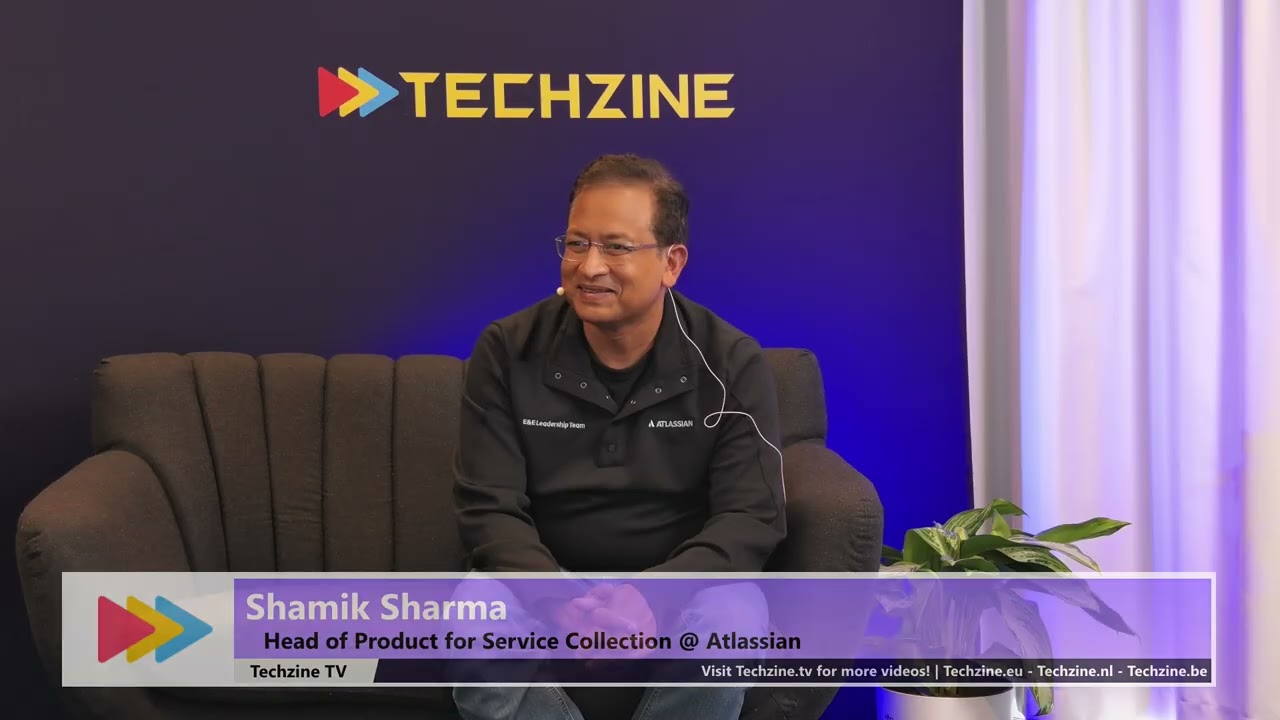
Atlassian’s Service Collection just crossed $1 billion in revenue — and the company’s head of product sat down with Techzine TV at Atlassian Team in Amsterdam to explain exactly how they got there, what’s coming next, and why the AI era may be Atlassian’s biggest opportunity yet.
If you think of Atlassian as a project management company, you may be looking at only half the picture. The Service Collection — bundling Jira Service Management, Customer Support Management, Assets, and Rovo Agents — is one of the fastest-growing segments in enterprise software right now. And in this exclusive interview, head of product Shamik Sharma pulls back the curtain on the strategy, the technology, and the hard problems that nobody in the industry has fully solved yet.
This is not a product demo. It’s a frank, detailed conversation that goes into territory most vendors avoid — including honest numbers on AI resolution rates, the real meaning of headless architecture, and the unsolved challenges that still keep the team up at night.
What you’ll discover in this video
Sharma goes deep on a range of topics that matter to enterprise IT and service management decision-makers. Here’s a taste of what’s covered — but watch the video to find out what the answers actually are:
The billion-dollar collection and the two-horse race
Analyst firm Forrester has made a striking claim about the current state of ITSM competition. Sharma addresses it directly — and explains what Atlassian’s position in the Gartner and Forrester quadrants actually means for customers considering a platform switch.
The #1 MCP server in the world — and what that tells you about headless adoption
A major hyperscaler has publicly named the Atlassian MCP server as the most-called MCP endpoint on the planet. Sharma explains what this means for how enterprises are actually consuming Atlassian technology today — and how Atlassian thinks about customers who never open the Atlassian UI at all.
The teamwork graph: a differentiator or just marketing?
Every major ITSM vendor claims to have a context graph. Sharma makes a specific, data-backed argument for why Atlassian’s is different — and a skeptical interviewer pushes back hard. The exchange is worth watching in full.
Assets: not just laptops
Find out how Atlassian defines an asset, which industries are pushing the boundaries of what the product can track, and how the company approaches verticals it doesn’t serve out of the box — from hospitals to shipping ports to field service operations.
AI resolution rates: what do the numbers really mean?
Competitors are claiming 60, 70, even 80% AI ticket resolution. Atlassian is publishing a different number — and Sharma gives a detailed breakdown of what’s actually inside that figure, why the comparison isn’t straightforward, and what a truly resolved ticket means in an enterprise context.
The two hardest problems in AI service management
Sharma names two specific challenges that the entire industry is struggling with, explains why they are harder than most vendors admit, and outlines how Atlassian is approaching each one — including how the AMP multi-agent framework addresses the trust problem at its root.
Why this interview is worth your time
- Understand where ITSM is heading and who the real competition is
- Learn what’s actually behind AI automation claims — before you evaluate vendors
- Find out whether the headless, MCP-driven approach to enterprise software is real or hype
- Get a clear picture of what asset management looks like in 2025 across multiple industries
- Hear a candid take on the limits of current AI from someone building the product
Hit play and decide for yourself whether Atlassian has earned its place in that two-horse race.