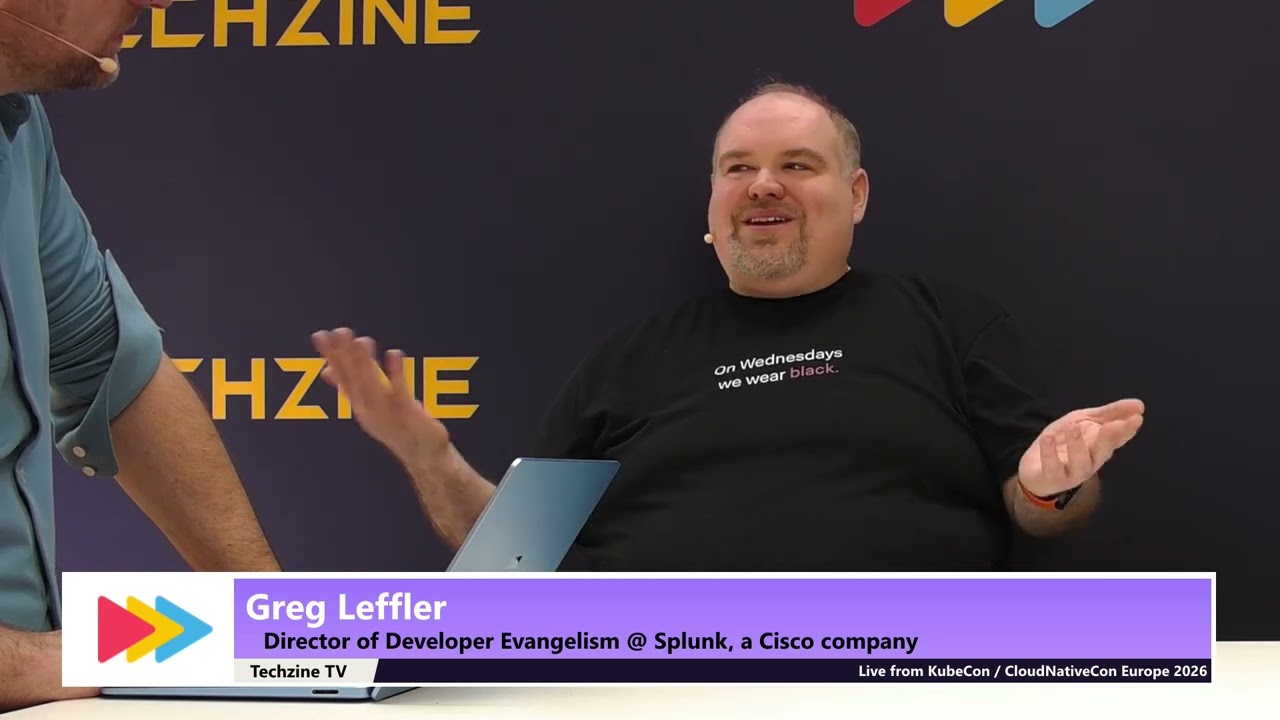
Is OpenTelemetry really as difficult to implement as its reputation suggests? And more importantly, why are the world’s largest organizations betting their entire observability strategy on it? In this KubeCon + CloudNativeCon 2026 interview, Splunk’s Director of Developer Evangelism reveals surprising truths about the state of cloud-native observability.
Greg Leffer manages developer evangelism at a company that contributes 30 full-time engineers to the OpenTelemetry project. In this conversation, he addresses the concerns developers raise about observability complexity and shares breakthrough technologies that are changing the implementation game.
If you’ve ever questioned whether the effort to instrument your applications is worthwhile, or wondered how to avoid vendor lock-in while maintaining comprehensive visibility into your systems, this interview provides answers you won’t find in product documentation.
What you’ll discover in this interview
The conversation challenges conventional thinking about observability implementation. You’ll learn why the “it works on my machine” mindset fails in production, and discover tools released just this year that can instrument applications without code changes, even compiled languages like Go and C++.
Leffer reveals how organizations are using eBPF instrumentation to monitor commercial applications they don’t even have source code for. He explains the crucial difference between data you own and data vendors claim as proprietary, and why this distinction matters when your infrastructure scales or your business needs change.
Key topics explored in depth
The video covers critical areas that affect every development and operations team:
- How automatic instrumentation actually works for both interpreted and compiled languages
- The real story behind OpenTelemetry’s difficulty reputation and what’s changed
- Strategies for observing SaaS applications and services you don’t control
- New semantic conventions for AI workloads and what they mean for LLM monitoring
- Cost management approaches that don’t sacrifice visibility
- Why operations teams will need to prove ROI more than ever before
- How security and observability are converging in cloud-native architectures
The vendor lock-in conversation you need to hear
One segment of the interview tackles a topic most observability vendors avoid: who actually owns your telemetry data? Leffer doesn’t hold back on why some vendors make it deliberately difficult to leave their platforms, and how OpenTelemetry was specifically designed to prevent this pattern.
You’ll understand why investing effort upfront with OpenTelemetry saves considerably more effort later, especially if your organization ever needs to change observability providers or expand to multiple platforms.
AI observability insights
As AI becomes central to business operations, monitoring these workloads presents new challenges. Leffer discusses recently released semantic conventions for AI data, why standardized naming matters more than it sounds, and how teams can now monitor token usage, response accuracy, bias, and hallucinations across different AI providers using unified dashboards.
The emerging approaches to instrumenting AI agents and other workloads reveal where the observability industry is heading as organizations deploy increasingly complex AI systems.
Learn more about observability
Whether you’re evaluating observability solutions for the first time or reconsidering your current approach, this conversation provides context that vendor demos and marketing materials simply don’t offer. Leffer speaks from the perspective of a company deeply invested in open source observability while also maintaining proprietary products, a balance that reveals important insights about where value actually lies in the observability stack.
Watch the full interview to understand how OpenTelemetry is maturing, where it’s heading, and why the world’s most sophisticated infrastructure teams are standardizing on it despite the initial learning curve.