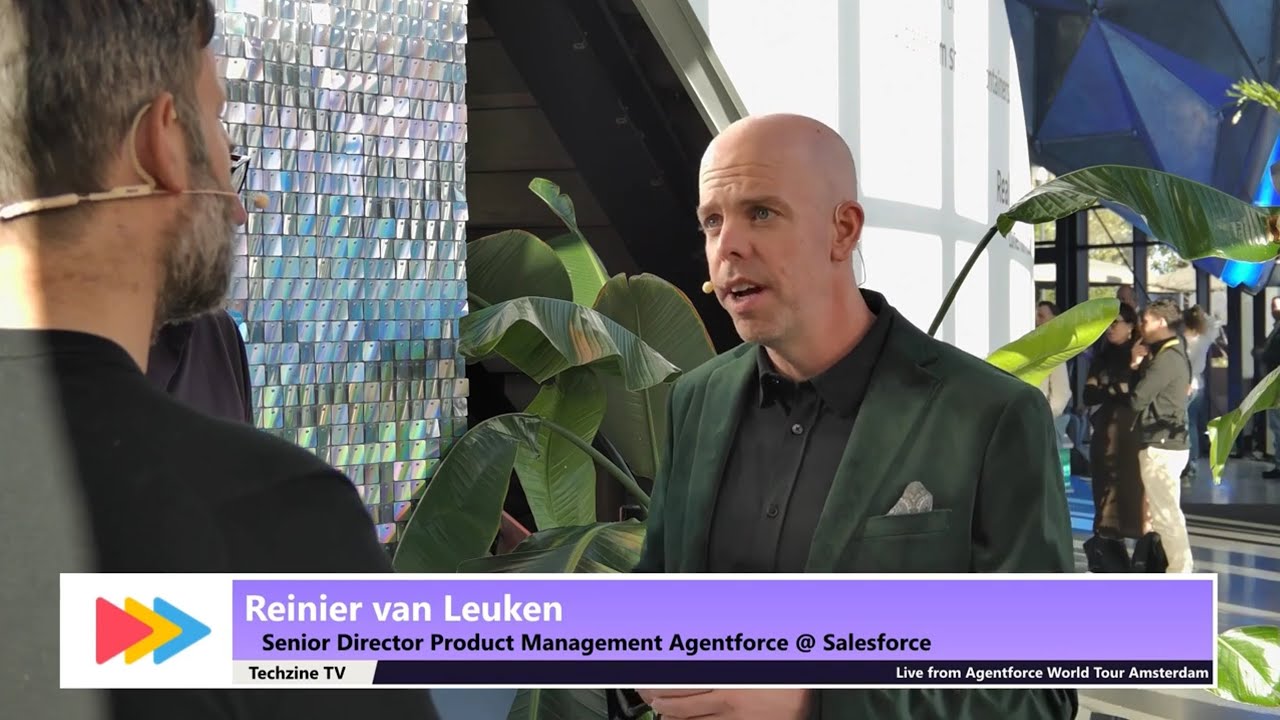
How does Salesforce ensure its autonomous AI agents won’t hallucinate critical business decisions or leak customer data? In this interview from Agentforce World Tour Amsterdam, the executive responsible for building the platform reveals the architectural innovations that make enterprise agents trustworthy enough for production deployment.
Reinier van Leuken, Senior Director of Product Management for Agentforce at Salesforce, walks through the technical decisions behind the platform that’s transforming enterprises into agentic organizations. This isn’t marketing talking, it’s a detailed technical discussion about how the platform actually works under the hood.
The conversation reveals why Salesforce takes a fundamentally different approach than consumer AI chatbots. They talk about the hybrid reasoning architecture that combines rigid business rules with creative language models, ensuring agents to follow policies while still sounding natural. Van Leuken explains how “controlling agents” monitor other agents in real-time, grading conversations and detecting when responses drift from approved data sources.
What you’ll learn in this video:
- Why large language models alone aren’t suitable for enterprise processes and how hybrid reasoning solves this fundamental problem
- The three-way relationship that determines whether an agent response is actually relevant to a customer question
- How the observability framework catches problems in real-time using AI to monitor AI
- What the Data360 platform provides that enables agents to remember previous customer interactions
- How MCP and A2A protocols allow Agentforce to work with agents from other vendors while maintaining security
- The specific security architecture that prevents data leakage even when external agents access Salesforce through interoperability protocols
- Why a multimodal agent for recommending adhesives took nine weeks to build and what that timeline reveals about realistic expectations
- The biggest mistake enterprises make when thinking about agent implementation
Van Leuken shares a fascinating real-world example of a company that built an agent to solve the “wall of confusion”. Helping customers standing in hardware stores choose the right adhesive by analyzing photos of broken items and asking contextual questions. This agent represents an entirely new business process the company couldn’t offer before, not just an efficiency improvement to existing workflows.
The discussion gets technical, discussing observability platforms and explaining how Salesforce trains specialized LLMs for monitoring other agents. For example, why relevance checking requires examining three separate relationships: answer to data, data to question, and answer to question. Most platforms only check the final relationship.
For security-conscious enterprises wondering how agent interoperability works without creating massive data exposure risks, Van Leuken details the authentication and access control architecture that maintains field-level permissions even through MCP servers. This addresses one of the most pressing concerns about the emerging agentic ecosystem.
Whether you’re evaluating agentic platforms, planning agent implementations, or trying to understand what makes enterprise AI different from consumer chatbots, this conversation provides technical depth you won’t find in a typical product video. Watch to understand the architectural decisions that determine whether autonomous agents can be trusted with mission-critical customer processes.