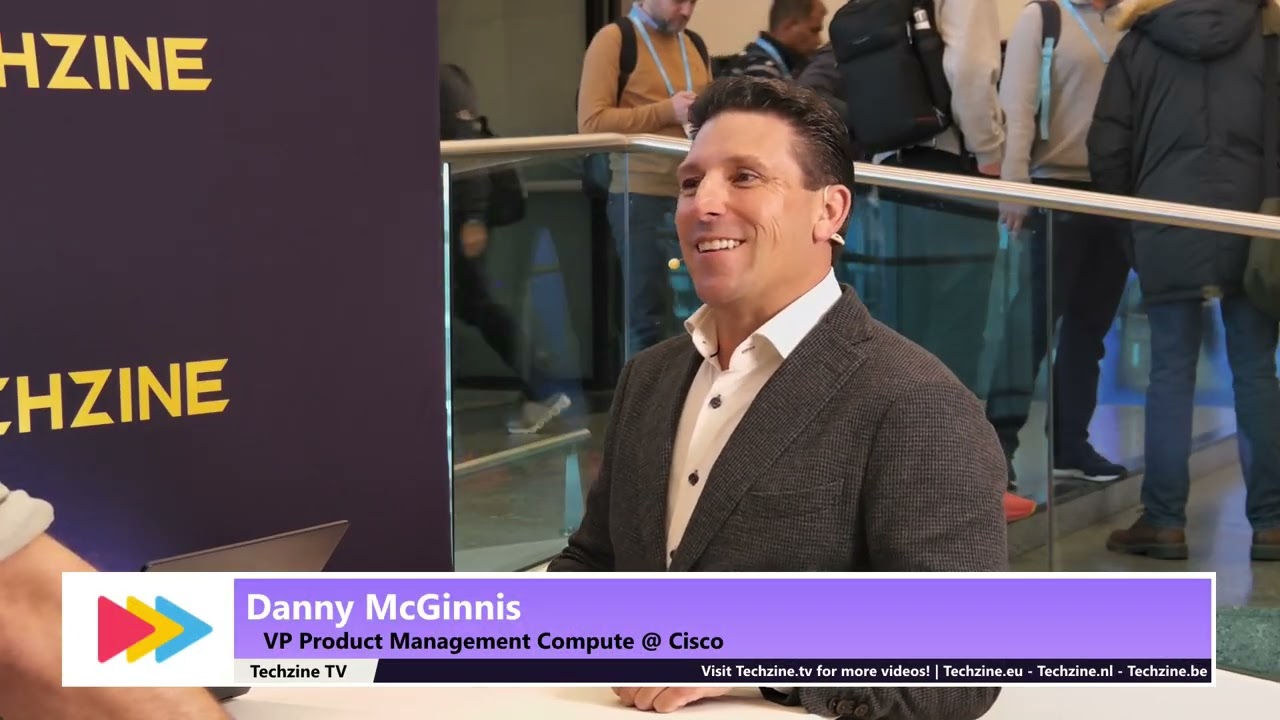
Discover how Cisco doubled down on compute and now wants to lead AI infrastructure innovation.
In this interview from Cisco Live EMEA in Amsterdam, Danny McGinniss, VP of Product Management for Cisco’s Compute Business, discusses with us what Cisco’s plans are from a compute perspective, especially compared to the rather dormant business unit it was only four, five years ago. What changed? How did Cisco go from a company where compute seemed like an afterthought to one confidently tackling the most demanding AI and edge computing challenges?
The conversation gets into innovations that sound impossible, like fitting eight 600-watt GPUs into a blade chassis without melting it, and also into why edge computing is finally becoming reality after 15 years of false starts. McGinniss is adamant that it’s different this time, and it has nothing to do with 5G.
You’ll learn about the behind-the-scenes challenge of keeping AI infrastructure recommendations current when software stacks change constantly, creating what McGinniss describes as a “constant house of cards.” He reveals how Cisco’s solutions teams work harder than ever to maintain validated designs that customers and partners depend on to navigate AI complexity.
What you’ll discover in this interview
McGinniss discusses the organizational change that made Cisco’s transformation possible, the appointment of the company’s first-ever Chief Product Officer in Jeetu Patel and how that galvanized different business units around common goals. He explains the “loosely coupled, tightly integrated” philosophy that lets customers benefit from full-stack integration without vendor lock-in.
The conversation provides insights about where AI workloads are actually being deployed, why blade servers are making a comeback, and how the persona-based approach to management tools helps different specialists work in their preferred environments while enabling operational teams to troubleshoot faster.
We also talk about the sovereignty challenge in Europe with McGinniss. That has become important for customers there, and get into capabilities people may not even know exist. We also discuss the reality of liquid cooling timelines, the road to extreme rack densities, and why starting with modest infrastructure often makes more sense than jumping to the biggest platforms.
Key topics explored
- The three-year transformation journey that repositioned Cisco’s compute business
- Engineering innovations enabling extreme density in blade servers
- Why AI CVDs require constant iteration unlike traditional validated designs
- How Unified Edge brings integrated compute, networking, and security to distributed locations
- The real driver making edge computing finally happen after years of predictions
- Intersight’s air-gapped capabilities for sovereign infrastructure requirements
- Security challenges when your attack surface drastically increases at the edge
- Why the AI discussion is fundamentally different from previous IT infrastructure conversations
- Virtualization alternatives and ecosystem partnerships in the post-VMware-Broadcom landscape
- What “shadow AI” means and why line-of-business leaders are driving infrastructure decisions