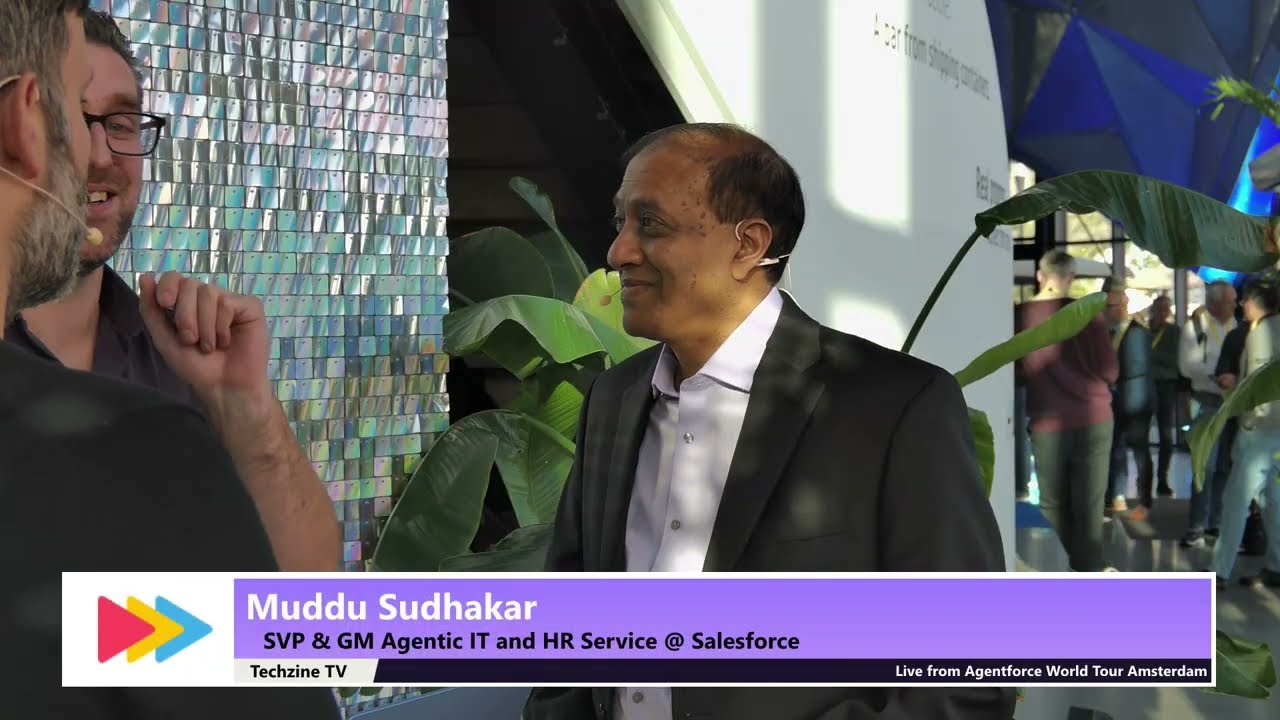
What happens when one of the world’s largest enterprise software companies decides to completely reimagine IT service management from the ground up? In this interview from the Agentforce World Tour in Amsterdam, you’ll discover Salesforce’s ambitious answer to that question.
Muddu Sudhakar, SVP and GM of Agentic IT and HR Service at Salesforce, pulls back the curtain on a platform that took 18 months and thousands of people to build. This isn’t an incremental improvement to existing ITSM tools, it’s a fundamental rethinking of how organizations should handle IT service requests in the age of AI.
Agentforce IT Service promises to solve 80% of IT issues before employees even open tickets, leveraging AI agents that proactively engage users when problems arise. But how exactly does it work? What makes this different from traditional ITSM? And most importantly, why are hundreds of enterprise customers already signing up?
What to expext from Agentforce IT Services?
Sudhakar explains the technical architecture behind what Salesforce calls a “unified, trusted, scalable” platform that combines Service Cloud, Agentforce, Data Cloud, and Mulesoft into a single stack. You’ll hear about the four distinct product areas they launched simultaneously and how they work together.
The discussion reveals fascinating details about the Agentic CMDB and service graph—technology that automatically discovers and maps your entire IT infrastructure, from network switches to applications, enabling sophisticated root cause analysis. But how does it collect all this data across diverse enterprise environments?
Strategic insights
Beyond the technology, this interview uncovers Salesforce’s go-to-market strategy and how it’s approaching customers with existing ITSM systems. Sudhakar’s candid responses about when to migrate (and when not to) provide valuable perspective for IT leaders evaluating their options.
You’ll also hear about the unexpected connection between IT service and HR service, and why Salesforce believes the future lies in unified employee experience platforms that span multiple domains. The implications for how enterprises structure their service operations could be profound.
The competitive landscape
While Sudhakar diplomatically avoids naming competitors, the timing is intriguing. This project started around the same time a major ITSM vendor announced plans to enter Salesforce’s CRM territory. What does this mean for the broader enterprise software market?
Future roadmap revealed
The conversation doesn’t stop at what’s available today. Sudhakar discusses upcoming capabilities including:
- Asset management for hardware and software
- GRC and IT compliance features
- Potential moves into observability and security
- Expansion of the partner ecosystem to 200+ integrations
- Build vs. buy decisions for future capabilities
Which features will Salesforce build internally? Where might acquisitions make sense?
Technical Deep Dive
For those interested in the technical details, the interview explores how Salesforce handles discovery across complex enterprise environments, processes telemetry data, and builds the service graph that enables predictive capabilities. The discussion of agentless discovery, agent-based approaches, and API integration provides insight into the platform’s flexibility.
Watch the full interview to understand whether Salesforce’s Agentic IT Service platform represents the future of enterprise IT operations. But also, what it means for your organization’s service management strategy.